Showing posts with label book structures. Show all posts

Wednesday, 30 March 2016

→ introducing physicians' almanac binding


English folding almanac in LatinMS.8932. Wellcome Library, 2014.

In the world of medieval English bookmaking, 15th century saw emergence of a physician's folded almanac. The book, which was produced to be carried around; where each page expanded individually to allow the medical practitioner access essential information on stars, saints and signs of Zodiac.


English folding almanac in LatinMS.8932. Wellcome Library, 2014.

Folded almanac belongs to the late medieval period, when astrology, science and magic coexisted in medicine. Almanacs were utilitarian tools, which helped physicians check the alignments of starts before making a diagnosis or commencing a treatment. They contained calendar (with saints' days), charts as well as diagram of Zodiac Man, which indicated the parts of the body as they were ruled by the signs of Zodiac.


English folding almanac in LatinMS.8932. Wellcome Library, 2014.

English folding almanac in LatinMS.8932. Wellcome Library, 2014.

English folding almanac in LatinMS.8932. Wellcome Library, 2014.

English folding almanac in LatinMS.8932. Wellcome Library, 2014.


The almanacs must have been abundant in the 15th century. By the end of the 1500s, physicians across Europe were required by law to calculate the position of the moon before carrying out complicated medical procedures, such as surgery or bleeding(2).


English folding almanac in LatinMS.8932. Wellcome Library, 2014.


By the end of the 1500s, physicians across Europe were required by law to calculate the position of the moon before carrying out complicated medical procedures, such as surgery or bleeding. - See more at: http://www.bl.uk/the-middle-ages/articles/medicine-diagnosis-and-treatment-in-the-middle-ages#sthash.1o8erWVQ.dpuf
The almanacs had a "best before" date - the astronomical and astrological data was only calculated for a period of about ten years. A physician could only safely consult the manuscript during those years, after which he would need an updated version of the calculations (4).  It is thought(4), that this is the reason why so few of them survived to this day.


English folding almanac in LatinMS.8932. Wellcome Library, 2014.


By the end of the 1500s, physicians across Europe were required by law to calculate the position of the moon before carrying out complicated medical procedures, such as surgery or bleeding. - See more at: http://www.bl.uk/the-middle-ages/articles/medicine-diagnosis-and-treatment-in-the-middle-ages#sthash.1o8erWVQ.dpuf
Almanacs - like contemporary books - were portable objects: they were produced to be carried around, often hung on the belt. They were built out of individual sheets of parchment, which were folded and sewn together to create a fan-like structure that allowed each leaf to be unfolded individually(1) - not unlike maps. Almanacs’ practical function suggests that they were both ephemeral – readily discarded and replaced – and relatively inexpensive to produce with (often) crude illustrations(3). The more lavishly decorated ones (as the one from Wellcome Library shown here), suggest that their ownership extended to the wealthier patrons, who might have not necessarily practiced medicine.

English folding almanac in LatinMS.8932. Wellcome Library, 2014.

English folding almanac in LatinMS.8932. Wellcome Library, 2014.


As seen from the images, the structure is similar to the map fold: the book is contained in a small case, but each page can be expanded into the space well beyond the size of the book. My brief online research suggests, that there are a few variants of the fold, including a type of concerina. A wonderful blog post by Teffania shows her attempts to recreate the almanac structure.


Teffania's Stuff


Teffania's Stuff


Teffania's Stuff


Teffania's Stuff


Teffania's Stuff


Teffania's Stuff


Teffania's Stuff


Sources:

1 Strådal, Sara Öberg (2016), Medieval Medical Diagrams: Meanings, Audiences and Functions. In Hectoren International: A Journal of Medical Humanities. http://www.hektoeninternational.org/index.php?option=com_content&view=article&id=154:medieval-medical-diagrams-meanings-audiences-and-functions&catid=93&Itemid=435

2 Bovey, Alixe. Medicine, Diagnosis and Treatment in the Middle Ages. In British Library http://www.bl.uk/the-middle-ages/articles/medicine-diagnosis-and-treatment-in-the-middle-ages

3 Brenner, Elma. The Enigma of the Medieval Almanac. In Welcome Library. http://blog.wellcomelibrary.org/2014/01/the-enigma-of-the-medieval-almanac/

4 Albright, Adrienne. Art and Science 4 – Celestial Bodies: Astrological Medicine in a Folding Almanac. In Before the Art. http://beforetheart.com/2013/07/18/art-and-science-4-celestial-bodies-astrological-medicine-in-a-folding-almanac/


Egidija


Wednesday, 3 February 2016

→ in the gutter

At PAGES book fair in Leeds, March 5-6, we will be presenting GUTTER - our curatorial experiment, which is an investigation into the contextual presence of book as an object and as art object, as well as an investigation into a curated event as a paradigmatic structure. (do come and see for yourself what this sentence actually means!)


As a result, gutter is something I could not help but notice as we were selecting  entries for prescriptions medical humanities and book arts exhibition, due at Beaney House of Art and Knowledge in April later this year.

Here are a few of the artists and their works I have noted down for their use of gutter space.


Wounds by Ruth Shaw-Williams documents some of her mother's many scars left by years of surgery. Ruth is interested in the visual articulation of that which has been hidden.  This involves the archiving of past hurts, coupled with documentation of the point at which they re-surface.


Ashely Fitzgerald considers the idea of the book as if it was a body that came to life with the spine of the book as the back bone and the pages as layers of flesh. The work G.B.S.  addresses her experience with a viral infection called Guillane-Barre Syndrome.


When speaking about gutter it is only appropriate to talk about guts and on innards: a collaborative project between Amanda Couch, Andrew Hladky, Mindy Lee and Richard Nash, which explores the changing conceptualisations of guts and digestion, their impact on the creative process and the role they play in constructing and destabilising our sense of self. The book is very appropriately spilling out of it's encasement with more parts being added to it as the project develops.


Derek's Story by Josie Valley is based on a narrative provided by Derek Cummings. Josie has created a visual response that is empathetic to his expressions of the multimodal experience of chronic illness in contemporary society.


Thursday, 19 March 2015

→ from book to film to book in a fanny dance

 .

(…) as we begin to read, a temporal process commences, which in addition to the two dimensions of surface and to the dimension of space—we think of the body of the book!—brings the fourth dimension of time. One of the essential characteristics of time is that the direction in which it moves is irreversible. (Hoculli, 1996)


→ FROM

When the moving image was first invented there was a tremendous excitement about the possibilities of the new medium. It was a spectacle on par with the magic shows. Georges Méliès produced The Haunted Castle and A Trip to the Moon. Lumière Brothers produced Le Squelette joyeux and Spanish Bullfight. Watching those films it is easy to see what the joy and the fascination were all about. It was "the cinema of attractions", as Tom Gunning called it, full of "visual delights…surprises…displays of exotic, beautiful or grotesque…or other sorts of sensational thrills “ (Abel, 2005)


Those early short films - each only about 4 minutes long - certainly used and explored the moving image with imagination and dedication of Caractacus Potts. The idea of film as a non-narratative medium (or where story-telling takes a secondary role) resembles a form of an artist's book, which excites the reader with form and content, rather then the verbal story on its pages (symmetry Nr1): a short blast of unfolding enjoyment.


→ 
The adjective “well-thumbed” tends to suggest a certain monomania regarding a text (Farry, 2015)
As soon as producers realised that longer films meant bigger profits, narrative cinema was born: Cinderella (Georges Méliès) and Alice in the Wonderland (by Cecil Hepworth and Percy Stow) were among the first to be made. 
The parallel between book and film goes beyond a direct book adaptation. Like film, codex is inherently sequential by it's structure: there are pages (film frames) and pages (film frames) and pages (film frames) that require time to ingest in a linear order from 1 to X hundred. (symmetry Nr2). McFarlane, in contrast, compares book to a literary narrative, distinguishing word as the smallest unit in the sequence. He rightly points out, that we do not watch film frame by frame as we read novel word by word. The comment would still stand even if comparing film/frame structure to the book/page structure. However, the principle of linear time-based sequenciality remains.
Like oral or cinematic narrative, it (literary narrative) can only be "consumed", and therefore actualised, in time that is obviously reading time, and even if the sequentiality of its components can be undermined by a capricious, repetitive, or selective reading. (Genette, 1980)


 BOOK TO FILM TO BOOK

Film editing process requires patience, stamina and precision of a typesetter, as I realised when editing between one hand and another. It was an illuminating experience, that had me appreciate  links between book and film production and  possible transitions that I had not yet considered.

When looking for more specific bridges between the two areas, I found that most conversions between the mediums happen in reference to their inherent sequentiality (symmetry Nr2). Flip books are the ones that came to my mind first. (Is it a film? Is it a book? Is it a toy?) Flip Books ! Un livre, un pouce, un film is probably the most remarkable project of them all. The film (which was screened at this years Pages book fair), includes an anthology of 300 activated flipbooks from Pascal FOUCHÉ’s collection (France - 2007). It traces the history from the XIXth century to today and it is subdivided into categories, such as dance, animals, artist's books, publicity, etc. Remarkably, there is "no dialog, no music, only the characteristic "flip" sound, in Stereo Dolby , wow !" 

The film certainly sounds fascinating - just like the whole business of flip-books. I will be coming back to the subject very soon.

The video below does not come from Flip Books ! Un livre, un pouce, un film - I found no quality images of the project online. This video is a credit to the amazing Flipbook Collector on YouTube - great channel!


→ 

Flip Books ! Un livre, un pouce, un film is a professional documentation of 300 books. But there are also documentation works of individual artists: artist's who work with all kinds of books (not just flipbooks) often resort to video to record their work. Because it is time-based. Personally, I like how our George documents his works. His videos and their presentation maintain the character of his books: they are a good step above a tipod+flipbook set-up. Below is an illustration from to every action there is a reaction. Take time to look at his other book videos. Immaculate.


→ 
 
And here is the most obvious work of them all. DOT (DOT: The book as a video and DOT: The book) The video is a sequence of digitally reproduced letterpress prints, produced in the typography workshop of the University of Arts in Braunschweig, Germany. The pages were collected and bound to three (almost) identical books. The project’s subheading refers to this coexistence of print and digital video.


It is an interesting project which requires spotless skills of a typesetter and a video editor. I loved the experimental idea of it, however - as for the rest - it was somewhat underwhelming. I wonder what Romano Hänni could have done with the video!


(…) as we begin to read, a temporal process commences, which in addition to the two dimensions of surface and to the dimension of space—we think of the body of the book!—brings the fourth dimension of time. One of the essential characteristics of time is that the direction in which it moves is irreversible. (Hoculli, 1996)


PS. → IN A FANNY DANCE 
Visual books use even more cinematic features: such as panning, flashbacks, eye-line matching, etc. I was also going to include video poetry (I did, in fact, and I deleted), photobooks and animation (flipbook linked), and then I realised that I was digging too deep and this whole blog post was getting out of my hands. So I stopped. Leaving some great subjects and artists to tackle next time.


Sources:

Abel, Richard (2005) "Cinema of Attractions." Encyclopedia of Early Cinema . New York. p. 124.
Buchan, Suzanne (2013) Pervasive Animation. Routledge p. 63
Chilyan, Tagui (2011) The Development of Narrative Film. Hitrecord: http://www.hitrecord.org/records/402381
Genette, Gerard (1980) Narrative Discourse. New York: Cornell University Press. p. 34. 
Hochuli, Jost & Kinross, Robin. Designing books: practice and theory. Hyphen Press. London,1996. p.12 
Farry, Oliver (2015) "The crack of the spine: why do we find wear and tear in books so comforting?". New Statesman: Feb 19, 2015 http://www.newstatesman.com/culture/2015/02/crack-spine-why-do-we-find-wear-and-tear-books-so-comforting 
McFarlane, Brian (1996) Novel to Film: An Introduction to the Theory of Adaptation. Oxford: Clarendon Press.


[Egidija]


Wednesday, 3 December 2014

scrolling gadgets {moving panoramas}

http://www.frieze.com/issue/review/tomas_saraceno/
Tomas Saraceno, Cumulus at Barbican


↓↓↓

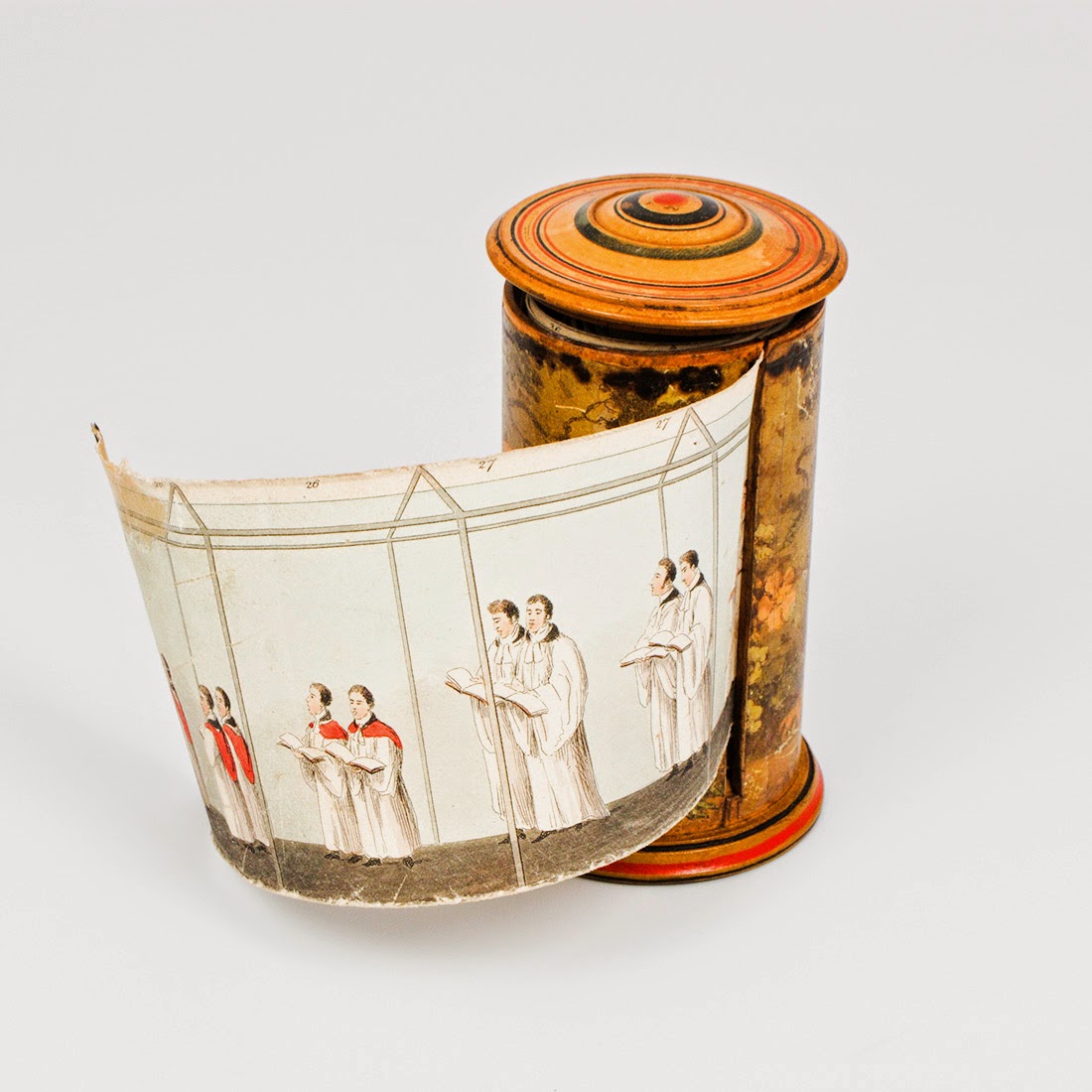
Some time ago I wrote a post digitised scrolls: from the Pond at Deuchar to the Trip to London, at the bottom of which I mentioned a charming Georgian device Trip to London that had been digitised by Princeton University. Trip to London is a box containing a twelve plate scroll that displays a humorous story of a honeymoon trip. It is a close development of the very popular moving panoramas, which came to Europe in late 17th century and by early 19th century they were so common, that there were even ladies' fans with miniature scrolled pictures incorporated into the designs. 


Trip to London

↓↓↓


Moving panorama - to put it simply - is a long panorama in a scroll, which has ends of it attached to two rods. The handles on the rods are then turned to allow the panorama to move across the screen, very much like a basic animation film. Moving panoramas were available in handheld scrolling devices as well as a form of large screen/stage entertainment. They were hugely popular: successful shows drew crowds and boasted years of performances. For example, Albert Smith's Ascent of Mont Blanc was performed for seven years at the Egyptian Hall in London, while Hugo d'Alesi's Mareorama allowed seven hundred spectators per viewing of this show, that offered a multisensory sea voyage illusion, complete with thunder, wind and local dancers.


a card promoting Hugo d'Alesi's Mareorama


Moving panoramas were extraordinary pieces of engineering. They often featured special enhanced sets and effects, merging of medias and mediums into one immersive spectacle. For example, touring panoramas of the late nineteen century England frequently included such novelties as mechanical puppets and slide projections. The most impressive ones, of course, were present at Exposition Universelle in Paris, 1900. The above mentioned Hugo d'Alesi's Mareorama incorporated two screens, each 2,500 feet long and forty feet in height, which were scrolled for the viewers present on board of the full size boat. The boat required hydraulic piston engines and pumps driven by electric motors to stimulate motion. 


Hugo d'Alesi's Mareorama


Another immersive panorama at Exposition Universelle in Paris was Pavel Yakovlevich Pyasetsky's Great Siberian Railway Panorama in the Russian pavilion. It offered a 45 minute experience of Trans Siberian rail journey complete with stuffed polar bears on papier-mache icebergs, a dinner of caviar and sturgeon in a luxury imitation train with a library, gymnasium, marble bath, smoking and music salons.


This 45-minute experience was an essay in detail. It offered a chance to experience the 14-day journey by rail from Moscow to Peking, a 6300-mile journey over tracks not yet completed at the time of the Paris Fair of 1900.
There were three realistic railway cars, each 70 feet long, with saloons, dining rooms, bars, bedrooms, and other elements of a luxury train. Totally detailed and lavishly equipped, the cars were elevated a little above a place for spectators in conventional rows of seats. The gallery faced a stage-like arena where the simulated views along the train trip were presented by an inventive contraption.
The immediate reality of a vehicular trip is that nearby objects seem to pass by more rapidly than distant ones. So, nearest to the participants was a horizontal belt covered with sand, rocks, and boulders, driven at a speed of 1000 feet per minute! Behind that was a low vertical screen painted with shrubs and brush, travelling at 400 feet per minute. A second, slightly higher screen, painted to show more distant scenery, scrolled along at 130 feet per minute. The most distant one, 25 feet tall and 350 feet long painted with mountains, forests, clouds and cities, moved at 16 feet per minute.
Real geographical features along the way were depicted on this screen: Moscow, Omsk, Irkutsk, the shores of great lakes and rivers, the Great Wall of China, and Peking. The screens, moving in one direction only, were implemented as a belt system. Due to the inexact speeds of the scenery,the 'journey' never repeated itself exactly, providing an ever-changing combination of scenes and a reason to pay to see the attraction again.  (from The Past Was No Illusion  by Walt Bransford)


Pavel Yakovlevich Pyasetsky's Great Siberian Railway Panorama

↓↓↓


Apart from the great spectacles at Exposition Universelle, 1900, there was a range of other - more common and more humble - weird and wonderful panorama devices. There existed pleoramas, dioramas, padoramas, myrioramas, phantom rides for public viewing as well as personal hand panorama reels, magic lanterns and peep-shows.


http://dip9.aaschool.ac.uk/references/
The Kaiserpanorama, 1900
http://motherboard.vice.com/en_uk/blog/remembering-the-human-gopros-that-gave-the-world
Phantom Ride
https://ore.exeter.ac.uk/repository/handle/10472/2843
Rotunda, Leicester Square
https://ore.exeter.ac.uk/repository/handle/10472/212
Coronation Procession of King George IV
https://ore.exeter.ac.uk/repository/handle/10472/4717
Tableau of the procession at the Queen's coronation June 28, 1838
http://writhingsociety.blogspot.co.uk/2010/02/myriorama.html
Myriorama or tableau polyoptique by Jean-Pierre Brès
(a set of cards that can be arranged in any order)


↓↓


Here are a few of the contemporary moving panoramas that range between overwhelming digital installations of Tomas Saraceno to painted paper scrolls of Adam Cvijanovic.

http://helendouglas.onlineculture.co.uk/ttp/ttp.html
Helen Douglas, The Pond at Deuchar
http://www.frieze.com/issue/review/tomas_saraceno/
Tomas Saraceno, Cumulus at Barbican
https://erindziedzic.files.wordpress.com/2013/09/rolling-panaorama-1_cvijanovic.jpg
Adam Cvijanovic, Rolling Panorama Number 1
http://upload.wikimedia.org/wikipedia/commons/8/8d/Panoramic_View_of_Old_City_lane_%28Pole%29_Ahmedabad.jpg
Panorama of Achmedabad


 ↓↓↓


The Trip to London scroll box is a story telling gadget that bridged book and upcoming cinema. It's situation is not dissimilar to the hybrid publishing projects emerging today as a result of media arts niche-ing themselves into the book market, such as FakePress and HybridBook. Moving panoramas were defeated by the cinema, of course. Which of the contemporary story telling gadgets are going to stay?


↓↓↓


Printed book sources:
Huhtamo, Erkki.  Illusions in Motion: Media Archaeology of the Moving Panorama and Related Spectacles, The MIT Press, Cambridge, London, 2013
Schwartz, Vanessa. Spectacular Realities: Early Mass Culture in Fin-de-SiècleParis. Berkeley: University of California Press, 1998.


[Egidija]


Wednesday, 15 October 2014

Digital scrolls (again)


Helen Douglas at Whitechapel Art Book fair, 2014

↓↓↓


The Art Book Fair at Whitechapel certainly looked different from the last year: upstairs had a much happier feel, with more tables filling the space and a refreshingly (!) large number of Canadian presses. Downstairs seemed as usual - big publishers and big tables. The cafe, however, was almost gone, with it's space in-between the floors occupied by a Blurb commission Unbinding the Book [why in the cafe?), which ranged between underwhelming and truly exciting. [Anyone knows what Imprimatur is? Is it a real imprint? Or is it merely a metaphysical concept from Blurb marketing department?] On the whole - a few hits and misses later - Whitechapel Art Book Fair was an improvement from the year before. 
  
(My personal favorite at Whitechapel, however, remained Kader Attia's Continuum of Repair: The Light of Jacob’s Ladder: a magnificent bookwork or a piece of installation - the choice is yours. )

One of the highlights of the fair itself was Helen Douglas’ new book, produced as a result of her residency in Mexico, where she traveled under the invitation from Martha Hellion. Surreal and mesmerising continuous sequence of images blends foliage, architecture, fragments of Mexican papercuts and textile into a seamless panorama. A garden of Eden? {seductive}. The Mexican book is not dissimilar in the many ways to the other books that Helen has been producing since 2001, that feature her trademark Thumberlina's perspective to draw in the viewer through the boundary of paper into the enchanted photographic foliaged images beyond. One of those works is her scroll book The Pond at Deauchar, which was conceived and produced as a physical scroll and as a digital scroll.


↓↓↓

Helen Douglas The Pond at Deuchar
There is a well known anecdote about how Helen Douglas wanted to produce the scroll as a digital app to accommodate The Pond at Deuchar.  Apple refused the idea, because the app did not include any more functions than scrolling the scroll (!).
Eventually the app for this artist's book was born and the pond can now be enjoyed online HERE.  It is a beautiful translation from one medium to another, that maintains the original fluidity and depth of immersion. In fact, the experience of the digital scroll excels as submersion into the work due to the level of detail that zoom option provides.


For comparison, below are a few more digitised scrolls by academic institutions. 


1. A library of digitised Asian scroll paintings at the University of Chicago.

Lake Zhiyang and the Eastern Lake 1663

There is a phenomenal incentive from the Center for the Art of East Asia at the University of Chicago - they have now uploaded online a library of digitised  Asian scroll paintings. What a resource!
The Center for the Art of East Asia initiated the Digital Scrolling Paintings Project to support the teaching of classes on East Asian painting. The temporal and spatial qualities of handscroll paintings are lost in photographs of selected sections that are reproduced in books and projected in the classroom.  Although used widely in current art education and the study of these works of art, such reproductions seriously distort the nature of handscrolls by erasing their sequential and participatory viewing process. The display of these paintings in long cases in museums also is not the way in which these paintings were made to be experienced. With the assistance of the Humanities Computer Research Department, the Center developed a prototype for digital scrolling technology as an exciting tool to simulate the viewing experience and to improve understanding of handscroll paintings.


2. Dead Sea Scrolls online by Google and Israel Museum in Jerusalem. 
Dead Sea Scrolls
In 2011 Google and Israel Museum in Jerusalem uploaded the oldest known biblical manuscripts Dead Sea Scrolls online in a high-resolution format, so they become available to all and everyone (with a reliable and fast internet connection, that is).


3. A Ripley scroll from 1477
Ripley Scroll (1477)
This Ripley scroll (1477) has been scanned-in as a very VERY hi-res very long photo and uploaded online: a delightful level of detail, that can otherwise be only enjoyed with a magnifying glass. In simple terms, it is an alchemical manuscript that shows in pictorial cryptograms the production of the philosopher's stone (the elusive ingredient that produces incorruptible gold out of lesser metals; and/or the elixir of life). A very detailed description of the scroll is on BibliOdyssey (among numerous other treasures that can be found there).


4. Georgian scrolling book Trip to London at Princeton University
Artist unknown, Trip to Town (London: William Sams, 1822). 
Box embossed: E.P. Sutton & Company; 
Sangorski & Sutcliff. GA 2005.01039
 And finally, here is this charming Georgian device Trip to London that has been digitised by Princeton University. It is a box with a twelve plate scroll that contains a story about a very unfortunate  honeymoon journey to London by a recently married Mister O'Squat and the Widow Shanks. 
Here is a POST from Booktryst (June, 2013) about the scroll, including this curious snippet of information.
It is not found in Tooley or Abbey, has no copies recorded by OCLC/KVK in institutional holdings worldwide, no copies at auction since ABPC began indexing results in 1923, no copy in the collection of the British Museum, nor is it found in the annals of our sister TV series, Divorce Court. It is an incredibly scarce item, as rare as a Taylor Swift long-term relationship.


↓↓↓


Digital editions raise questions about... editions: what is the relationship between the digital and the material version of the book? Is it an edition in its own right? Prof. Michelle Brown spoke of digital manuscripts in the article she wrote for our Codex: Between This and That book. She suggested that digital editions should be treated as born digital editions in their own right.
The exponential increase in digital imagery available online is encouraging scholars accustomed to working on early texts in the form of printed editions to become aware of the value added and transformative experience of working directly from the primary sources, without having to travel around the world and negotiate access to materials, the rarity and fragility of which may necessitate curatorial restrictions on access to be applied – as in the case of the Beowulf manuscript itself. Manuscript curators initially anticipated that digital surrogates would lessen the demand for consultation of the original; in fact, the stimulation of interest that they provoke can often lead to even more requests to view. Scholarly scepticism is such that there is also felt to be a need to see the original for oneself, in order to test the veracity of digital versions – which indeed have their own life and should be seen as born digital e-manuscripts in their own right.
 Born digital e-scrolls in their own right, then.


[Egidija]

The original version of this post can be found in Egidija's Notebook II.