Monday, 27 July 2015

→ illegible writing (almost)/ #asemic

Some time ago I had a pleasure to see Bruno Munari's libre Illegible at Estorick Collection in London. Libre illegible contained no texts, titles or tables of content. Instead, they could only be "read" as a tactile, acoustic and visual experience. Libre illegible later became one of the key sources of inspiration for our project between one hand and another. Investigation into those illegible books has led me to uncover a world of non-textual "reading" and "writing" - visually beautiful illegible and almost-illegible pieces produced by writers, scientists, poets, artists, spies, adventurers and scribblers of all sorts: some - as a philosophical artistic investigation; some - as communication; others - as encrypted communication.

↓  philosophical artistic investigation


http://www.invaluable.com/auction-lot/bruno-munari-acrylic-on-paper-1587-c-f4c4b77917
Bruno Munari. Scrittura Illeggibile di un Popolo Sconosciuto

Bruno Munari himself had produced a series of works titled Scritture illeggibili di popoli sconosciuti (Illegible Writings of Unknown People), using asemic writing, based on Arabic and Chinese characters. Asemic writing implies presence of written communication. However, due to it's a-semic nature, interpretation relies on the implications drawn from visual information.


Cecil Touchon, Palimpsest Asemic Correspondence 
Cy Twombly, Letter of Resignation
http://bombmagazine.org/article/7461/untitled-and-diario-no-1-a-o-1
Mirtha Dermisache, Diario Noº 1 Año 1
http://www.cuifei.net/works/manus5.htm
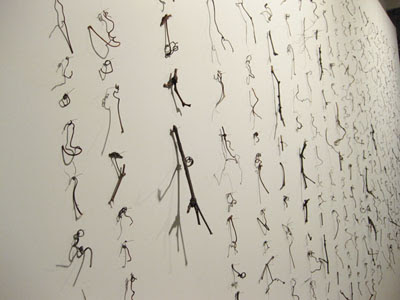
Cui Fei, Manuscript of Nature V
Donna Maria de Creeft, Asemic Journal
Guy Beinin, So is the one (a visual poem)* 

Asemic script suggests presence of written communication. It relies on apophenia - a human tendency to see meaningful patterns where they do not exist.Of course, asemic witting is created by people who have experience of reading and writing texts in their native languages - it is based on the knowledge of what a legible written communication looks like. As a result, any asemic language can only exist as a conscious reduction of that experience and unconscious imitation of the languages the writer does not understand - which probably explains, why much of European asemic writing looks like Arabic or Asian scripts.

↓  communication

This is not really an example of illegible writing, rather it is an example of visually beautiful writing practice from the 19th century, when it was a custom to cross-write letters in order to save paper. It look only little experience, they say, to read and write successfully in this way, learning to ignore the overlapping text.


Jane Austen

Charles Darwin
Another 19th century example is a translation. It is produced by an Alaskan Eskimo shaman, who having converted to Christianity attempted to translate the Bible into his tribe’s native script. Biblical names are in English/Latin script -  as there was no equivalent. This page appears to be from Genesis 19, about the two angels who visited Lot, before Sodom and Gomorrah were destructed (currently at Basel Paper Mill, Museum for Paper, Writing and Printing).
 

↓  encrypted communication

 The most famous example of yet unresolved encrypted writing is Voynych Manuscript, of course. It is generally agreed that the manuscript is written in an unknown writing system. As speculations on the nature and the source of the text multiply, the manuscript remains undeciphered. It remains illegible, or - an example of a beautiful asemic writing.
Voynich manuscript
A rather better story lies behind The Copiale Cipher - a mysterious 18th century document that no one could read until 2011. The Copiale Cipher describes the rituals and some of the political ideals of a German secret society in the 1730s. Bellow is an interesting extract about one of the rituals involving reading.
The master places a piece of paper in front of the candidate and orders him to put on a pair of eyeglasses. “Read,” the master commands. The candidate squints, but it’s an impossible task. The page is blank. The candidate is told not to panic; there is hope for his vision to improve. The master wipes the candidate’s eyes with a cloth and orders preparation for the surgery to commence. He selects a pair of tweezers from the table. The other members in attendance raise their candles. The master starts plucking hairs from the candidate’s eyebrow. This is a ritualistic procedure; no flesh is cut. But these are “symbolic actions out of which none are without meaning,” the master assures the candidate. The candidate places his hand on the master’s amulet. Try reading again, the master says, replacing the first page with another. This page is filled with handwritten text. Congratulations, brother, the members say. Now you can see.


The Copiale Cipher

Every language is an example of encrypted communication: the message only makes sense to those who have the keys to decoding, those being vocabulary and grammar. Until we have the keys, the writing remains asemic to the individual reader: writing remains a drawing with a potential to be decoded.

Such as this Japanese calligraphy is to me.

Japanese poem by Lady Murasaki Shikibu from Ogura (early 13th century) 

めぐりあひて 見しやそれとも わかぬ間に 雲がくれにし 夜半の月かげ

 "Meeting on the path:

But I cannot clearly know If it was he,

 Because the midnight moon

In a cloud had disappeared." 

(calligraphy by yopiko)


[Egidija]

Wednesday, 24 June 2015

→ the photo book (part II): between documentation and memory (@ Photographers' gallery, London)


Georges Didi-Huberman has recently been awarded Theodor-W.-Adorno-Preis 2015, which is given for outstanding achievement in philosophy, music, theater or film. Some years ago he wrote Images In Spine of All, in which he discussed four explicit photographs of mass extermination in Nazi camps. Huberman put the voyeur, the history and the art into one line of questioning. Photography, he said, rested between documentation and memory.
A simple piece of film - so small that it can be hidden in a tube of toothpaste - is capable of engendering an unlimited number of prints, of generations and enlargements in every format. Photography works hand in glove with image and memory and therefore possesses their notable epidemic power. (Huberman, p24)

↓↓↓

As a Lithuanian, I must start this blog with Moshe Vorobeichic. In 1931 he published Paris (as Moi Ver), one of the very first photo artists' books ever produced. At about the same time, however, he published another photo book Ein Getto im Osten - Wilna (1931), documenting the Jewish quarter in Vilnius, where he himself grew up. Like Paris, Wilna book is equally avant-garde in it's collages and layouts. Yet, it is also a very intimate book: the viewer is brought very close to the faces, the puddles, the baskets of Vilnius Jews. The reader is led though the back streets and the markets; the reader looks at the rooftops and the pavement; the reader meets residents of the Jewish quarter. This book is not a record of a historical point in time, rather it is a personal reference point to somewhere in his childhood, soaked in black-and-white nostalgia.


↓↓↓

Photographers' Gallery at the moment is hosting a Chinese photo book exhibition curated by Martin Parr and WassinkLundgren. The exhibition space is tight, but there are large double-page-spread photos, videos of books, books to handle (albeit chained) and books to look at under the glass.


The exhibition does not solely focus on the artists publications, but brings together the whole range of photographic books, pamphlets, promotional material under one umbrella. There is no line between photo books as artists' publications and institutional albums, produced to document an aspect of research, such as tongue conditions or bridges. Does a distinction between photo book as a document and photo book as a creative practice, rest on the maker's intentions only, rather then certain qualities of the outcome? Ed Ruscha recorded gasoline stations, while Chinese government recorded bridges. Both resulted in photo books.


The Hairy People of China


Basics of soccer - a series of techniques

This merging of intentions is what I found so pleasing about the exhibition: there were instructions on the correct ways to play sports and then there were artists' publications, such as the beautifully cinematic  This Face portrait book by Xu Yong.


 Zi U's face was photographed during various times of the day: with make-up and without, tired and refreshed. She is a sex worker. She sees clients from very close and she is used to be seen from close. The sequence of photographs forms an intimate portrait similar to that produced by a film: the trace of the real Zi U is captured in-between the page spreads and the viewer, in-between proximity and truth, in-between memory and document.

Photographers' Gallery also contained an exhibition of Deutsche Börse Photography Prize 2015 (now closed). Mikhael Subotzky and Patrick Waterhouse - the winners - had the work in the first room for their mammoth long term project documenting the fate of Johannesburg's Ponte City. The prize was awarded "for their ambitious publication Ponte City (Steidl, 2014), charting the social and political history of a 54-floor apartment block in Johannesburg", which was built under apartheid rule in 1976 and was originally conceived as a center of aspirational living for a white elite.  A sequence of books follows the temporal line of events, with an introductory pamphlet - containing newspaper headlines - placed at the front. The narrative is built one step at a time by thoughtful sequencing of images and texts. The work balances between the space of historical documentation and artistic interpretation, merging the boundary between the the objective fact and subjective elucidation. 


↓↓↓

As a young teenager I collected photo books of my city. They were published once every few years. I did not own a camera - I documented my space and time in another way. Like those Chinese photo books - which show the correct way to play soccer - Kaunas photo books reflected the correct Soviet way to see my town. They are not voyeuristic (like Xu Yong's book), they are not nostalgic (like Moshe Vorobeichic book) and they only have the intimacy of a travel agent's photography. Yet, they stand as a document and they stand in for memory. Because they contain photographs.
Photographed images do not seem to be statements about the world so much as pieces of it, miniatures of reality that anyone can make or acquire. (Sontag, On Photography)


↓↓↓


1. Susan Sontag also argues against photo books, because they determine the order in which photographs are to be viewed. Like cinema, photo books sequence images as determined by artist's intentions. It is in the nature of the photo book to be sequenced. Yet, it is also in the nature of the book as such to accommodate a random access option for the viewer should one desire to exercise such.


References:

images Egidija's own, except for M. Vorobeichic (Moï Ver), Ein Ghetto im Osten – Wilna, 1931, which were taken from achtung.photgraphy website.


Didi-Huberman, G (2008), Images in Spite of All: Four Photographs from Auschwitz, Chicago: University of Chicago Press.
Sontag, Susan, On Photography http://www.susansontag.com/SusanSontag/books/onPhotographyExerpt.shtml, June 21, 2015.


[Egidija]

Thursday, 19 March 2015

→ from book to film to book in a fanny dance

 .

(…) as we begin to read, a temporal process commences, which in addition to the two dimensions of surface and to the dimension of space—we think of the body of the book!—brings the fourth dimension of time. One of the essential characteristics of time is that the direction in which it moves is irreversible. (Hoculli, 1996)


→ FROM

When the moving image was first invented there was a tremendous excitement about the possibilities of the new medium. It was a spectacle on par with the magic shows. Georges Méliès produced The Haunted Castle and A Trip to the Moon. Lumière Brothers produced Le Squelette joyeux and Spanish Bullfight. Watching those films it is easy to see what the joy and the fascination were all about. It was "the cinema of attractions", as Tom Gunning called it, full of "visual delights…surprises…displays of exotic, beautiful or grotesque…or other sorts of sensational thrills “ (Abel, 2005)


Those early short films - each only about 4 minutes long - certainly used and explored the moving image with imagination and dedication of Caractacus Potts. The idea of film as a non-narratative medium (or where story-telling takes a secondary role) resembles a form of an artist's book, which excites the reader with form and content, rather then the verbal story on its pages (symmetry Nr1): a short blast of unfolding enjoyment.


→ 
The adjective “well-thumbed” tends to suggest a certain monomania regarding a text (Farry, 2015)
As soon as producers realised that longer films meant bigger profits, narrative cinema was born: Cinderella (Georges Méliès) and Alice in the Wonderland (by Cecil Hepworth and Percy Stow) were among the first to be made. 
The parallel between book and film goes beyond a direct book adaptation. Like film, codex is inherently sequential by it's structure: there are pages (film frames) and pages (film frames) and pages (film frames) that require time to ingest in a linear order from 1 to X hundred. (symmetry Nr2). McFarlane, in contrast, compares book to a literary narrative, distinguishing word as the smallest unit in the sequence. He rightly points out, that we do not watch film frame by frame as we read novel word by word. The comment would still stand even if comparing film/frame structure to the book/page structure. However, the principle of linear time-based sequenciality remains.
Like oral or cinematic narrative, it (literary narrative) can only be "consumed", and therefore actualised, in time that is obviously reading time, and even if the sequentiality of its components can be undermined by a capricious, repetitive, or selective reading. (Genette, 1980)


 BOOK TO FILM TO BOOK

Film editing process requires patience, stamina and precision of a typesetter, as I realised when editing between one hand and another. It was an illuminating experience, that had me appreciate  links between book and film production and  possible transitions that I had not yet considered.

When looking for more specific bridges between the two areas, I found that most conversions between the mediums happen in reference to their inherent sequentiality (symmetry Nr2). Flip books are the ones that came to my mind first. (Is it a film? Is it a book? Is it a toy?) Flip Books ! Un livre, un pouce, un film is probably the most remarkable project of them all. The film (which was screened at this years Pages book fair), includes an anthology of 300 activated flipbooks from Pascal FOUCHÉ’s collection (France - 2007). It traces the history from the XIXth century to today and it is subdivided into categories, such as dance, animals, artist's books, publicity, etc. Remarkably, there is "no dialog, no music, only the characteristic "flip" sound, in Stereo Dolby , wow !" 

The film certainly sounds fascinating - just like the whole business of flip-books. I will be coming back to the subject very soon.

The video below does not come from Flip Books ! Un livre, un pouce, un film - I found no quality images of the project online. This video is a credit to the amazing Flipbook Collector on YouTube - great channel!


→ 

Flip Books ! Un livre, un pouce, un film is a professional documentation of 300 books. But there are also documentation works of individual artists: artist's who work with all kinds of books (not just flipbooks) often resort to video to record their work. Because it is time-based. Personally, I like how our George documents his works. His videos and their presentation maintain the character of his books: they are a good step above a tipod+flipbook set-up. Below is an illustration from to every action there is a reaction. Take time to look at his other book videos. Immaculate.


→ 
 
And here is the most obvious work of them all. DOT (DOT: The book as a video and DOT: The book) The video is a sequence of digitally reproduced letterpress prints, produced in the typography workshop of the University of Arts in Braunschweig, Germany. The pages were collected and bound to three (almost) identical books. The project’s subheading refers to this coexistence of print and digital video.


It is an interesting project which requires spotless skills of a typesetter and a video editor. I loved the experimental idea of it, however - as for the rest - it was somewhat underwhelming. I wonder what Romano Hänni could have done with the video!


(…) as we begin to read, a temporal process commences, which in addition to the two dimensions of surface and to the dimension of space—we think of the body of the book!—brings the fourth dimension of time. One of the essential characteristics of time is that the direction in which it moves is irreversible. (Hoculli, 1996)


PS. → IN A FANNY DANCE 
Visual books use even more cinematic features: such as panning, flashbacks, eye-line matching, etc. I was also going to include video poetry (I did, in fact, and I deleted), photobooks and animation (flipbook linked), and then I realised that I was digging too deep and this whole blog post was getting out of my hands. So I stopped. Leaving some great subjects and artists to tackle next time.


Sources:

Abel, Richard (2005) "Cinema of Attractions." Encyclopedia of Early Cinema . New York. p. 124.
Buchan, Suzanne (2013) Pervasive Animation. Routledge p. 63
Chilyan, Tagui (2011) The Development of Narrative Film. Hitrecord: http://www.hitrecord.org/records/402381
Genette, Gerard (1980) Narrative Discourse. New York: Cornell University Press. p. 34. 
Hochuli, Jost & Kinross, Robin. Designing books: practice and theory. Hyphen Press. London,1996. p.12 
Farry, Oliver (2015) "The crack of the spine: why do we find wear and tear in books so comforting?". New Statesman: Feb 19, 2015 http://www.newstatesman.com/culture/2015/02/crack-spine-why-do-we-find-wear-and-tear-books-so-comforting 
McFarlane, Brian (1996) Novel to Film: An Introduction to the Theory of Adaptation. Oxford: Clarendon Press.


[Egidija]


Tuesday, 24 February 2015

→ currious lens devices between the reader and the world

[ this blog post was first published at Wednesday Post by Collective Investigations]


An instrument of natural magic may reappear as a philosophical instrument, as an instrument of entertainment, or as a practical "invention" in a new guise" (Hankins and Silverman, 1995)


I.


and all we are left with is the world
window vinyls and a set of three artists’ books, including viewing devices


On Wednesday, February 25th, 2015 In a Bookshell opens at Milton Gallery @
St Paul's School, SW13 9JT, London. Among many wonderful, innovative, surprising and creepy pieces of bookworks Collective Investigations will also have two pieces on display: 1. between one hand and another (a video installation) and 2. and all we are left with is the world (book installation). This blogpost refers to the first one.


and all we are left with is the world is an installation about perception. It consists of three artist's books and three viewing lenses on the window sill. The books contain scholarly quotes on optics, solipsism, and sensory experience. The lenses guide viewer’s attention to the book and then through it and into the warped space beyond, inviting us to consider the systems of perception as part of our relationship with the surrounding environment.


II.

Books and spectacles go together like horse and carriage, strawberries and cream, oysters and champagne (not quite, but always worth mentioning). Stereotypical geeks carry books and wear glasses. Bill Gates does, for example. Apparently, 53% of university graduates are nearsighted and require reading aids, as compared with 24% of those, who did not even complete secondary education.

Glasses, like books, feature often in portraiture of academically accomplished individuals and those would would wish to be considered as such. For ages men have used spectacles as props to embellish the aura of their professionalism in painting and photographs, says William Rosenthal, a collector of visual aids (Rosenthal, 1996).

and all we are left with is the world (see above ) deals with the metaphysics of looking through a lense and the sensory-perceptual experience of it. Below, I will mention a few fun, curious and wonderful devices that a part of the history of spectacles.


Apparently, there is no such thing as concise history of spectacles, because there is no agreement as for who and where invented them. Marco Polo observed elderly Chinese use spectacles in 1270. Chinese claim, that spectacles originated in the 11th century Arabia. (1)  In the meantime, in Europe Vikings were already able to grind lenses out of rock crystal. However, "proper" first spectacles are often attributed to the Italians of the Veneto region. (2)

With the invention of mechanical printing and subsequent rapid growth of publishing industries, the need for reading devices increased and inexpensive spectacles became widely available from peddlers. Finally, in the 1600s the spectacles as we recognise them now were born: the two lenses were finally fixed to a rigid bridge allowing them to stay in place on top on the nose. (1)


a.)


From 17th century spectacles were were sold by instrument makers, who also traded in compasses, zograscopes, telescopes and other fantastical "scientific toys", that coexisted together with a range of other more or less useful instruments. Among them, were faceted lenses - multiplying glasses - which were used for entertainment and were treated as a luxury commodity (Stafford and Terpak, 2001).


b.)
 

Another use for faceted lenses came in the form of perspective glass, or vue d'optique, which produced a convincing sense of perspective.


 c.)
  

Personally, I find optical fans most fascinating! Some fans had tiny telescopes set into the centers, others had lorgnette frames folding away into the guardsticks. However, the most exciting were spyhole fans. 
For short sight a single concave lens could be mounted in one of the spyholes, effectively forming a Quizzer or Quizzing Glass. This was then further developed into a Galilean telescope by mounting a convex lens in the outer guardstick and a concave lens in the inner guardstick. Lining up the holes in the intervening sticks, when the fan was closed and the blades rested upon one another, produced a simple tube with a lens at each end. The resulting spyglass could even be adjusted for focus by varying the separation of the closed sticks. (3)


III. 

Lens devices used in art, including book art, are varied, but not abundant. Here are a couple of the works that I found most interesting. I have chosen one work of each (kind of) category.


a.) installation lens/vision


Haruka Kojin explores the distortion of reality through her piece "Contact Lens". Two types of lenses are used, one completely flat and clear and the other with a warped surface to create interconnected circles of varying sizes. As the light travels through the acrylic, the images on the other side are flipped and contorted, changing the experience of the space. since the elements are clear with no frames or distinct features of its own, the physical material merges into the environment, only visible through the transformation it causes. 
b.) installation lens/light
 

IPOcle by Candas Sisman is a light installation produced with lenses, light, mirror, sound, container, and fog. It simulates the way we perceive the reality that exists in our physical world and the various layers, variables, cycles that are present in this process of perceiving. These perceptions draw our perceptual schemas and these schemas in turn shape the reality we perceive. Our perceptions and what we perceive, therefore, constantly reshape call each other into being, as in a vicious cycle. At this point, how can we define what reality really is, what constant can we refer to, and aren’t we supposed to look at this issue in a more holistic and intertwined manner?

c.) book lens/vision
  ↓ 

Strictly speaking, this is not a work that uses lens in the optical sense of it. Artist's book READ by Jackie Batey is about the act of reading. The book was inspired by Our Mutual Friend and takes the first 20 pages of this novel but hides within them a Dickens' quote about reading. The quote describes reading as being like a code, whereby the initiated can open the world of books. The quote is hidden word by word on each page in pale turquoise that can only be seen clearly when viewed through the red lens on of the magnifying glass.


c.) artefacts lens/surprise
  ↓ 


A Glimpse of Heaven by Keith Lo Bue is an optical device made of Industrial shop ruler, clockspring, brass, brass hardware, steel, engraving, book end paper, glass bead, lenses, paper, text, soil. Keith Lo Bue tries to make connections between disparate phenomena: reality and surreality; preservation and decay; memory and forgetting. There is a deliberate effort to create in the artwork a fragile technology of bone and soil, exhumed from the scattered shards of lives preceding our own.


.

An instrument of natural magic may reappear as a philosophical instrument, as an instrument of entertainment, or as a practical "invention" in a new guise" (Hankins and Silverman, 1995)


 Sources:

(1) Ophthalmic Heritage & Museum of Vision
(2) The College of Optometrisists
(3) Online Museum and Encyclopaedia of Vision Aids 


Hankins, Thomas L. and Robert J. Silverman. 1995. Instruments and the Imagination. Princeton: Princeton Univ. Press. p. 221.
Rosenthal, William J. 1996. Spectacles and Other Vision Aids. San Francisco, CA: Norman Publishing. p. 358.
Strafford, Barbara Maria and Frances Terak (eds.) 2001. Devices of Wonder: from the World in a Box to Image on a Screen. Los Angeles: Getty Publications. p185.

[Egidija]